The enzyme is a process input
Activity, dose and conditions determine the effect. Record the enzyme preparation, lot, dose and actual treatment conditions. A treatment that is not recorded cannot be repeated or investigated when clarity changes.
Clarification & finishing · Stage 06
Apply a food-grade enzyme preparation with controlled dose, mixing, temperature and residence before separation or filtration.
THE PROCESS DUTY
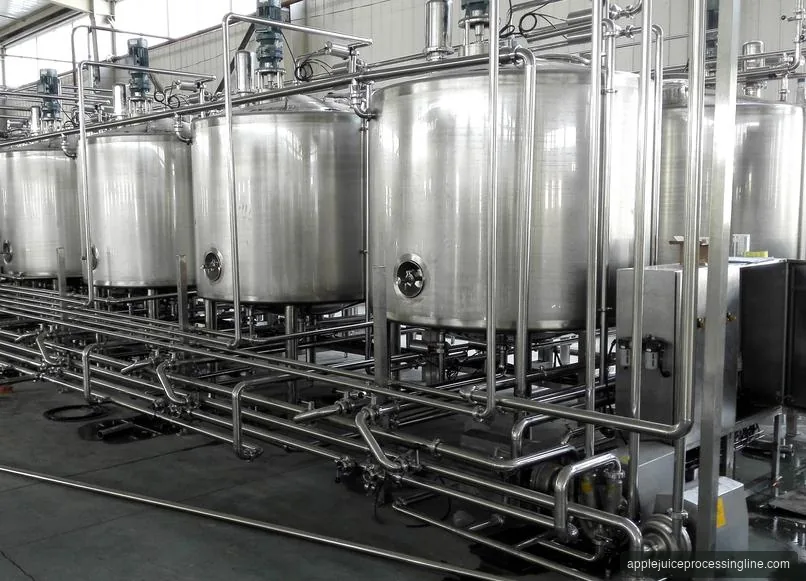
An enzymatic treatment system doses, mixes and holds apple juice under defined conditions so a selected enzyme can act. It is not a generic tank with an addition point. Dose accuracy, mixing, temperature control, residence time and cleaning determine whether the treatment is repeatable. The enzyme preparation and its intended use must be approved for the product and jurisdiction.
IN THE LINE
The equipment is only useful when its feed and discharge are defined. These adjacent duties are the first interfaces to review.
WORKING PRINCIPLE
The explanation starts with the material and the process, not a catalogue description.
Activity, dose and conditions determine the effect. Record the enzyme preparation, lot, dose and actual treatment conditions. A treatment that is not recorded cannot be repeated or investigated when clarity changes.
The enzyme must contact the juice uniformly without excessive foaming or air entrainment. Inline mixing or a gentle agitated tank can work; the choice depends on the flow and residence time. Dead zones create untreated juice.
A holding tank or tube provides the residence time required by the trial. Temperature control may be needed to keep the reaction within the intended range. The hold step should be included in the cleaning and production schedule.
The reaction may need to be stopped or the juice moved promptly to separation. Define what happens at the end of the hold, during a stoppage or when the juice is out of specification. Do not leave the step without a defined disposition.
WHERE IT FITS
WHAT TO WATCH
CONFIGURATION OPTIONS
These are the choices that change the equipment scope. The approved datasheet fixes the final selection.
Manual, metered or automatic addition with a defined calibration method.
Inline mixer or agitated tank selected around the juice and residence time.
Tank or tube with a defined volume and flow, and access for cleaning.
Heating or cooling if the enzyme requires a controlled range.
Dose, flow and hold-time recording appropriate to the project.
SELECTION FACTORS
Bring these points to the equipment discussion. They are more useful than a single throughput number.
The preparation must be suitable for apple juice and the intended clarification effect.
Established by trial, not copied from another juice or product.
The hold volume follows flow and residence time, not the tank's nominal size.
Residual enzyme and juice must be removed between runs.
SPECIFICATIONS
No catalogue model or performance figure is shown until the configuration is approved. The final datasheet fixes these items.
| Specification area | What is defined in the approved datasheet |
|---|---|
| Capacity basis | Juice flow and required residence time |
| Dosing | Enzyme preparation, dose range and calibration method |
| Mixing | Inline or tank mixing selected for the juice |
| Hold | Volume, flow and temperature conditions defined |
| Cleaning | CIP or manual cleaning and drainage included |
| Documentation | Treatment record fields, trial basis and approved datasheet |
Provide your product, capacity basis and available utilities to move from this selection framework to a project-specific datasheet.
TECHNICAL FAQ
If your question depends on the fruit, product or site, include the conditions in the enquiry rather than relying on a general answer.
Send a project enquiryYes, if the addition is measured, mixed and held under defined conditions. Manual addition without records is difficult to repeat. A controlled dosing and mixing step is usually easier to verify.
No. Enzyme preparations have specific activities and act under specific conditions. The result depends on the juice, dose, time and temperature. Clarification performance should be confirmed by trial.
Not always. Some juices can be clarified by other means, but pectin-rich juice may need enzymatic treatment. The decision should come from the juice and the target clarity, not from a fixed process template.
The stop condition depends on the enzyme and process. It may be temperature, time, separation or another step. Define it with the enzyme supplier and process designer, and include it in the operating instructions.
YOUR PRODUCT. YOUR PROCESS.
Tell us the product, the quantity basis and the packaging. We will work back through the process to the equipment scope.